
Pyrite Testing Terrebonne
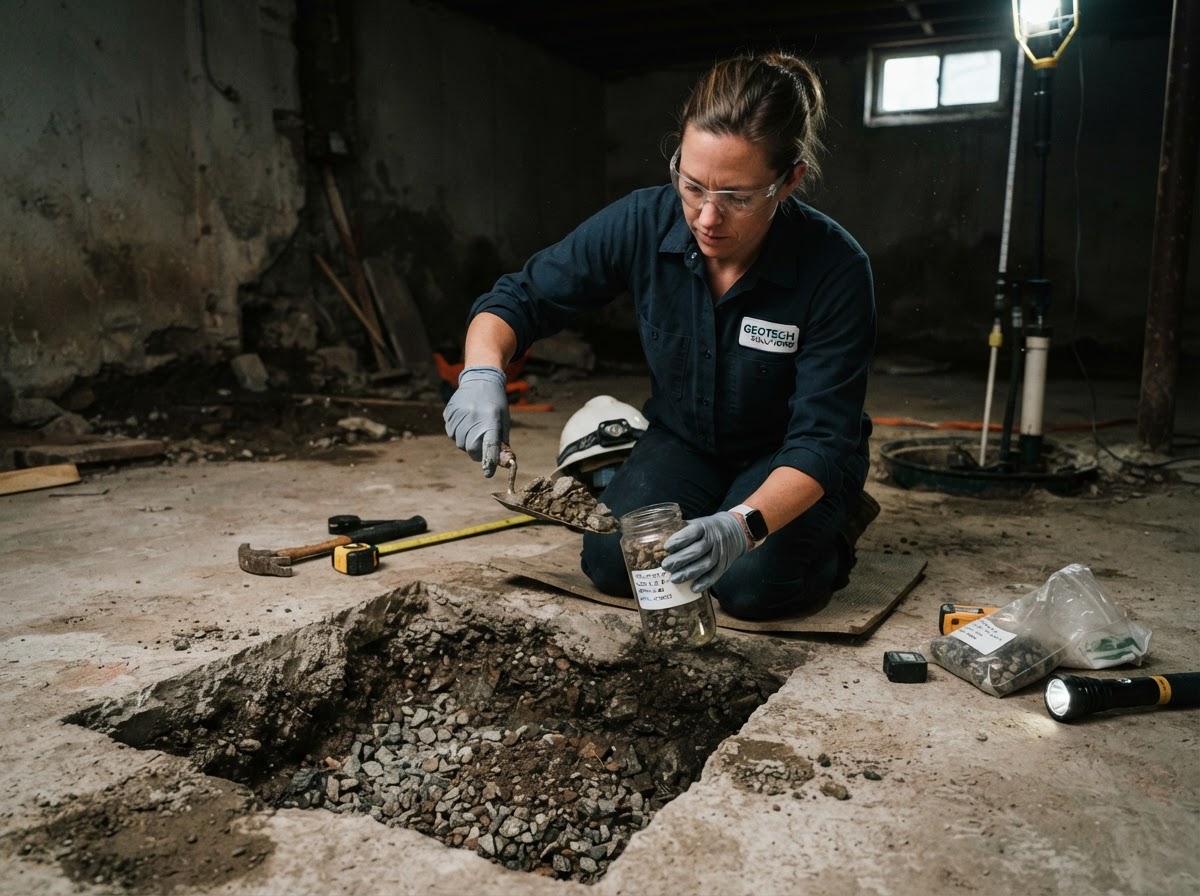
Pyrite testing following the CTQ-M200 protocol, from backfill sampling to the IPPG results certificate.
In Terrebonne, part of the North Shore / Laurentians area, our certified inspectors and engineers deliver this service directly to local owners, buyers, and condo boards — with the same rigorous process and detailed reporting offered across Greater Montreal.
Star-shaped cracks in the concrete slab, floor heaving, door frames that no longer close properly? These signs can indicate the presence of pyrite in the backfill under your slab — a common problem in certain areas of Greater Montreal. Only a lab test following the CTQ-M200 protocol can confirm the diagnosis with certainty.
Radar Inspection performs pyrite testing in Montreal, from sampling through to the final results certificate.
Request your free quote — 514-550-2444 | info@radarinspection.com
What the service includes
- Complete visual inspection of the slab, foundations, and walls
- Targeted core sampling of the concrete slab
- Backfill sampling under the slab (and underlying natural soil if required)
- Accredited lab analysis (IPPG)
- Careful sealing of sampling points
- Laboratory results certificate with recommendations
Price Calculator
Estimate the price of your pyrite test based on the number of samples required.
Results delivered within 7 business days
1 sample selected.
Estimated price
CA$625.00
- 1 sample · CA$625.00
- GST (5%)CA$31.25
- QST (9.975%)CA$62.34
- TotalCA$718.59
Book directly based on our availability.
Is your area at risk?
Some areas of Greater Montreal are more frequently affected by pyrite. Search your city or neighborhood below.
South Shore (Montérégie)
- Longueuil
- Brossard
- Boucherville
- Saint-Jean-sur-Richelieu
- Chambly
- Saint-Bruno-de-Montarville
- Saint-Basile-le-Grand
- Candiac
- La Prairie
- Châteauguay
- Delson
- Sainte-Catherine
- Saint-Constant
- Saint-Amable
- Varennes
Island of Montreal
- Rivière-des-Prairies
- Pointe-aux-Trembles
- Pointe-Claire
- Dollard-des-Ormeaux
- Beaconsfield
- Kirkland
- Pierrefonds-Roxboro
- Baie-D'Urfé
- L'Île-Bizard–Sainte-Geneviève
Laval
- Sainte-Dorothée
- Fabreville
- Chomedey
- Laval-Ouest
- Laval-sur-le-Lac
Lanaudière
- Repentigny
- Le Gardeur
- L'Assomption
- Terrebonne
- Mascouche
Lower Laurentians
- Blainville
- Boisbriand
- Mirabel
- Rosemère
- Sainte-Thérèse
- Saint-Eustache
This list reflects the areas most frequently affected based on our observations and is not exhaustive. Regardless of your municipality, contact us at 514-550-2444 or info@radarinspection.com to check the situation in your area.
What Is Pyrite and Why Does It Cause Damage?
Pyrite (iron disulfide) is a mineral sometimes present in the granular backfill used under concrete slabs. In the presence of water and oxygen, it oxidizes and generates sulfates that cause the backfill to swell, exerting upward pressure on the slab and foundations. This chemical process progresses slowly, often over several years, before damage becomes visible.
CTQ-M200 is Quebec's reference protocol for assessing the swelling potential of backfill containing iron sulfides. It was developed to standardize analysis and avoid conflicting diagnoses between labs. The test produces a Petrographic Swelling Potential Index (IPPG), which determines the risk level:
- IPPG 0-10: negligible swelling potential
- IPPG 11-20: low swelling potential
- IPPG 21-40: low to moderate swelling potential
- IPPG 41-60: moderate to high swelling potential
- IPPG 61-80: high swelling potential
- IPPG 81-100: extremely high swelling potential
What to Do Based on Your Result
An IPPG of 0 to 20 (negligible to low) generally suggests simple monitoring. An IPPG of 21 to 60 (low-to-moderate, or moderate-to-high) warrants closer follow-up and further assessment. An IPPG of 61 to 100 (high to extremely high) generally requires backfill replacement — surface treatment does not stop the ongoing chemical reaction.
Why Radar Inspection
- Disclosure obligation: in municipalities identified as at-risk, the OACIQ requires brokers and sellers to disclose any known pyrite risk
- Protect your investment: an undetected pyrite problem can lead to major repair costs (full demolition and replacement of the slab)
- Negotiate with full knowledge during a real estate transaction
- Properly plan the work if backfill replacement proves necessary
- Document a financial assistance application, where applicable, for homes damaged by pyrite or pyrrhotite

Our process
Complete visual inspection
Of the slab, foundations, walls, and upper level, looking for signs of distress.
Targeted core sampling
Of the concrete slab, at one or more strategic locations.
Backfill sampling
Under the slab and, if needed, of the underlying natural soil, following the CTQ-M200 protocol.
Accredited lab analysis
To determine the Petrographic Swelling Potential Index (IPPG).
Careful sealing of sampling points
With certified crushed stone and fast-setting concrete.
Laboratory results certificate
With the IPPG index obtained and our recommendations.
Signs That Warrant Pyrite Testing
- Star-shaped or spider-web cracks in the concrete slab
- Visible heaving of the basement slab
- Whitish powder (efflorescence) appearing on the concrete surface
- Doors and frames that stick or no longer align correctly
- Cracks in foundation walls or apparent movement
- Misalignment of floors or partitions on the upper level
These signs can also be caused by other phenomena (soil settlement, clay swelling, freeze-thaw cycles). Only a lab analysis can confirm or rule out pyrite with certainty.
Frequently asked questions
Related services


Ready to book your pyrite testing?
Pyrite testing following the CTQ-M200 protocol, from backfill sampling to the IPPG results certificate.